LINA
Weekly Averages vs Daily Weigh-ins: What Actually Works
Daily weigh-ins can look chaotic. Learn why a weekly weight average is the clearer way to track progress.
Last updated: 2026-01-14
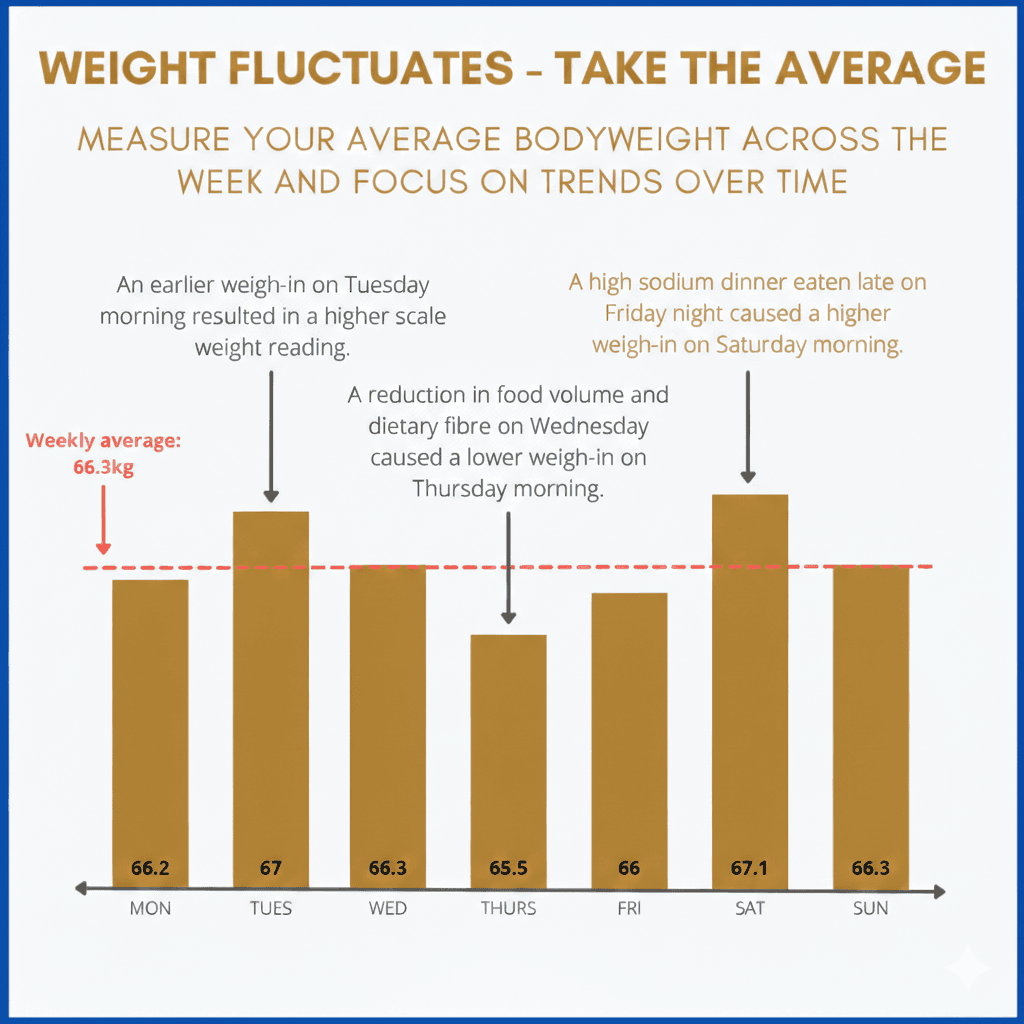
Daily numbers are noisy, not wrong
Daily scale readings swing because water, glycogen, sodium, food volume, stress, and sleep move faster than fat loss.
That is why daily numbers are noisy even when your plan is working.
Weekly averages smooth out water weight
A weekly weight average blends seven data points so temporary water shifts cancel out.
This turns daily weigh-ins vs weekly into a signal vs noise decision, not a willpower test.
Step by step: calculate your weekly weight average
1) Weigh daily under the same conditions (morning, after bathroom, before food).
2) Add the seven numbers from Monday through Sunday.
3) Divide the total by 7 to get your weekly weight average.
4) Compare this week vs last week instead of day vs day.
Simple example table (text-based)
Day | Scale (kg)
Mon | 80.2
Tue | 80.8
Wed | 80.1
Thu | 80.5
Fri | 79.9
Sat | 80.0
Sun | 79.7
Weekly average = (80.2 + 80.8 + 80.1 + 80.5 + 79.9 + 80.0 + 79.7) / 7 = 80.2 kg
How to interpret trends over 2 to 4 weeks
Use the weekly average as the decision point and look at the slope across 2 to 4 weeks.
If the average is flat or rising for 2 to 4 weeks, adjust calories or activity. If it is trending down, stay consistent.
Why this works long term
Daily weigh-ins give you data, but the trend tells the truth and keeps emotions in check.
Trend-based tracking is the most sustainable method.
LINA landing sections
Related tracker pages
Put this into action with LINA
LINA tracks daily weight and highlights the weekly average so you can focus on the trend. LINA app to keep calories, macros, and habits in one place.